
P.I.T. of Despair
DoD throws spanner in council’s £38M anti-flooding works

Declaration of Dumfries has had some astonishing freedom of information responses from Dumfries & Galloway Council over the years—not least when we forced DGC to confirm that they had no authority to mask Other People’s Children during the ‘Covid pandemic’.
But now we have a response possibly even more incredible (as in not credible) than that.
In the FOI (link) titled ‘Greensands/Whitesands Common Good Status’ DGC were asked:
We request the following in relation to the areas of common good land at Whitesands and Greensands, Dumfries affected by the Whitesands Flood Protection Scheme:
1. The official status of the land as either inalienable or alienable common good, together with the documentary evidence the Council relied upon in reaching that status (e.g. titles, dedications, deeds of trust, historic usage determinations, or internal/external legal advice).
2. Confirmation of whether the Council has petitioned the Court under section 75(2) of the Local Government (Scotland) Act 1973 in relation to the appropriation or change of use of that land.
If yes, please provide copies of the pleadings, interlocutors, or orders.
If no, please provide the documentary basis for not seeking such a petition.
Section 75(2) of the Local Government (Scotland) Act 1973 states:
75 Disposal, etc., of land forming part of the common good.
(2) Where a local authority desire to [ F1appropriate or] dispose of land forming part of the common good with respect to which land a question arises as to the right of the authority to alienate, they may apply to the Court of Session or the sheriff to authorise them to [ F1appropriate or] dispose of the land, and the Court or sheriff may, if they think fit, authorise the authority to [ F1appropriate or] dispose of the land subject to such conditions, if any, as they may impose, and the authority shall be entitled to [ F1appropriate or] dispose of the land accordingly.
Put simply, this means that, where a local authority intend to remove, sell or change the use of Common Good property that is classed as ‘inalienable’ then the authority must apply for permission to do so through the courts.
Here is DGC’s response to question one:
Q1 The whole extent of common good land at Whitesands and Greensands,
Dumfries affected by the Whitesands Flood Protection Scheme is currently
assessed as being inalienable.
So, the whole extent of the common good affected by the Whitesands project is admitted by DGC to be inalienable, meaning s. 75(2) of the Act is activated… right?
Question two.
Q2 No application has been made to court under section 75(2) of the Local
Government (Scotland) Act 1973. The basis of not doing so is legal advice
received from our internal Legal Services.
So the common good land is admittedly inalienable… but they have not applied for court permission. There’ll be a good excuse for this, surely?
It seems DGC decided to apply an ‘exception’ called the ‘Public Interest Test’:
“This exception is subject to the ‘public interest test’ . . . we have considered if the public interest in disclosing the information outweighs the public interest in applying the exception . . . on balance, the public interest lies in favour of upholding the exception . . . there is a greater public interest in the local authority having free and frank discussions with our Legal Services.”
For anyone struggling to get their head round what just happened, the council have basically just stated:
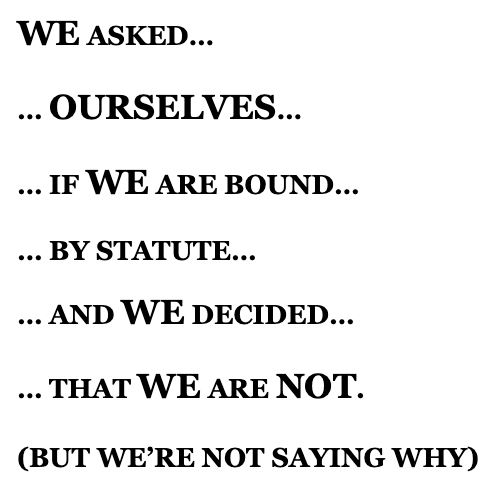
Surely a government body is indubitably bound by the very rules that created it, no?
If not, then the question that arises is this:
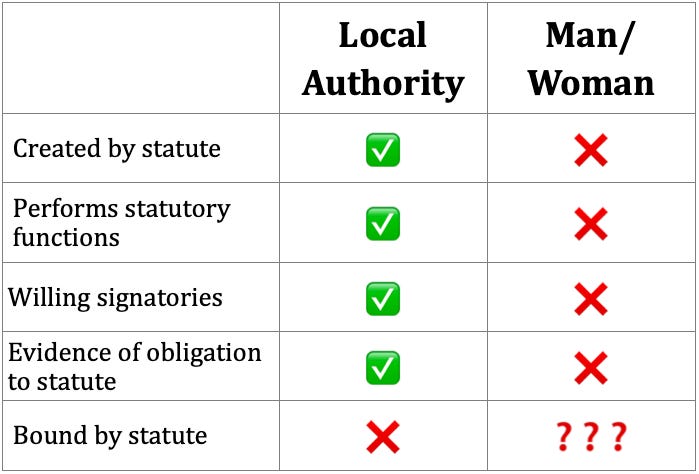
If an entity created by statute, performing functions of a statutory nature, staffed by people who have willingly signed up to a statutory role, with evidence of obligation in abundance, IS NOT BOUND by statute…
Then how is it possible that an entity… that was NOT created by statute… does NOT perform statutory functions… that never willingly signed up to anything… with no evidence of obligation to those rules… IS BOUND by them?
Here it is visualised.
If you’re now wondering why you’re really obliged to obey government regs (such as paying Council Tax, for example), you’re not alone, and neither are you alone if you think the council’s excuses are somewhat suspicious.
An anonymous legal source commented:
“The Public Interest Test (PIT) that they mention is basically a lawyers “Safety Blanket”… from a legal standpoint, if I see anything mentioning the PIT, then I am already aware that whatever the case relates to, isn’t being done entirely legally. The PIT is used regularly in cases that lawyers are… treading a fine line between legal and illegal…
“It is not something that should ever be trusted, and should it ever be contested in court, there is a very high chance that the council would lose.”
We agree. DoD believes that the council is being economical with the truth and, in its desperation, has dug itself a PIT.
And DoD knows what to do about it.
DoD
Right of Reply: Contact DoD@DeclarationofDumfries.co.uk with additional or alternative information. Anonymity guaranteed.
Yes, there have been recent inquiries into the status and potential development of common good land in Dumfries, specifically the areas known as Whitesands and Greensands.
Common Good Land Status
In September 2025, a Freedom of Information request was submitted to Dumfries and Galloway Council seeking clarification on the legal status of the land at Whitesands and Greensands. The request aimed to determine whether these areas are classified as inalienable (protected from sale or development) or alienable (subject to potential disposal or change of use). Additionally, the request sought information on any legal processes the Council might have undertaken to change the status or use of this land, including whether the Council had petitioned the Court under section 75(2) of the Local Government (Scotland) Act 1973, which pertains to the appropriation or change of use of common good land.
Whitesands Flood Protection Scheme
The Whitesands area has been the subject of a proposed flood protection and public realm improvement scheme. This project aims to address the regular flooding issues in the area, which have historically affected property and infrastructure. The scheme includes flood protection measures as well as enhancements to the public space, such as improved landscaping, pathways, lighting, seating, and play areas. The Council has emphasized the importance of respecting the unique history, heritage, and cultural assets of the area while implementing these improvements.
Community Concerns
Local residents have expressed concerns about the potential impact of the proposed developments on the character and use of the common good land. For instance, a petition has been circulated opposing the construction of an earth bund (a raised embankment) on the Whitesands, arguing that such a structure would significantly alter the town's landscape and public space.
Additionally, there have been calls for transparency regarding the extent and legal status of the common good land at Whitesands and Greensands. Residents have requested layout plans showing the physical boundaries of these areas and information on any changes to their status or usage over time. They seek assurance that any alterations to the land's use have been conducted through lawful and transparent processes.